Your garage door contains over 300 individual parts working together through approximately 1,500 cycles per year, making it the largest moving component in most homes. Understanding these components and maintaining them properly prevents costly emergency repairs, extends equipment lifespan by years, and keeps your family safe from one of the most dangerous household systems.
This comprehensive guide breaks down every major garage door component, establishes clear maintenance schedules tailored to Valley Springs conditions, and helps you distinguish between safe DIY tasks and situations requiring professional intervention. Whether you manage residential properties, own a service business, or simply want to protect your investment, you’ll find actionable guidance for keeping garage doors operating reliably.
Understanding Your Garage Door System: Essential Parts and Components
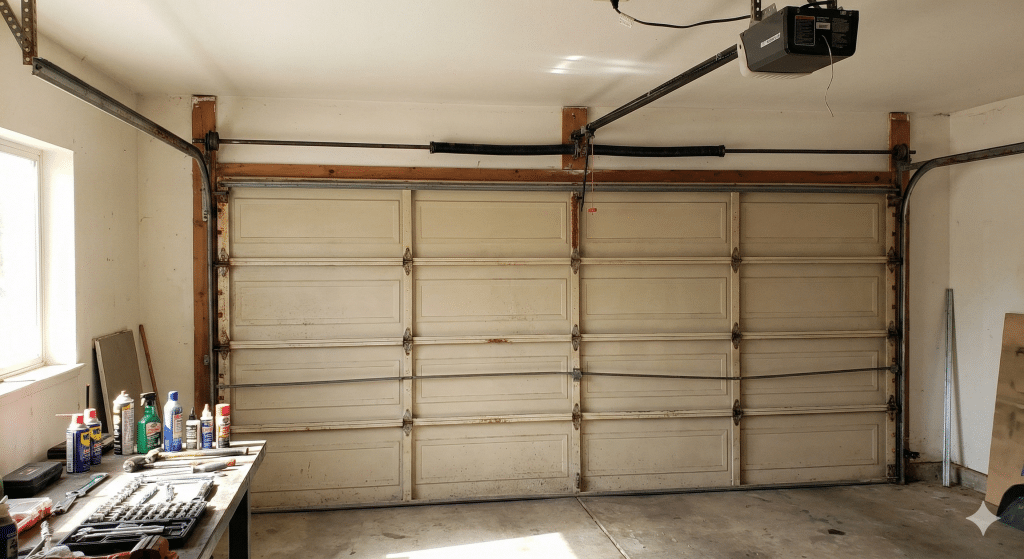
A modern garage door system integrates mechanical, electrical, and safety components into a coordinated assembly. Each part serves a specific function, and understanding these roles helps you identify problems early, communicate effectively with technicians, and make informed decisions about repairs versus replacements.
Door Panels and Sections
Garage door panels form the visible barrier between your garage interior and the outside environment. Most residential doors consist of four to five horizontal sections connected by hinges, allowing the door to curve along the track system during operation.
Panel materials significantly impact durability, insulation value, and maintenance requirements. Steel panels dominate the market due to their strength-to-cost ratio, though aluminum offers lighter weight for oversized openings. Wood panels provide aesthetic appeal but demand regular sealing and painting to prevent moisture damage. Fiberglass and vinyl options resist denting and corrosion, making them suitable for coastal or high-humidity environments.
Insulation within panels affects energy efficiency and noise reduction. Polystyrene insulation (foam boards) provides basic thermal resistance, while polyurethane insulation bonds directly to panel surfaces, adding structural rigidity alongside superior R-values. For Valley Springs homes experiencing temperature swings between seasons, insulated doors reduce HVAC strain and maintain more consistent garage temperatures.
Weatherstripping along panel edges and the bottom seal prevents air infiltration, water intrusion, and pest entry. Bottom seals typically use rubber or vinyl materials that compress against the garage floor. Side and top weatherstripping fits into channels along the door frame. These components deteriorate faster than panels themselves, requiring inspection and replacement every few years.
Springs: Torsion vs. Extension
Springs counterbalance the door’s weight, making it possible for openers to lift doors weighing 150 to 400 pounds using relatively small motors. Without properly functioning springs, your opener would burn out rapidly, and manual operation would be nearly impossible.
Torsion springs mount horizontally above the door opening on a metal shaft. When the door closes, cables wind around drums at each end of the shaft, rotating the spring and storing energy. Opening the door releases this stored energy, effectively lifting most of the door’s weight. Torsion systems provide smoother operation, longer lifespan, and better balance than extension alternatives.
Extension springs mount along the horizontal tracks on either side of the door. They stretch when the door closes and contract to assist opening. While less expensive initially, extension springs create more wear on other components and pose greater safety risks if they break without containment cables installed.
Lifespan expectations depend on cycle ratings. Standard springs handle approximately 10,000 cycles, translating to roughly seven to nine years for average households. High-cycle springs rated for 25,000 or more cycles suit high-traffic applications or homeowners wanting longer intervals between replacements.
Critical safety warning: Garage door springs store tremendous energy under tension. A breaking spring releases this energy instantaneously, capable of causing severe injury or death. Spring replacement requires specialized tools, training, and safety protocols. This is not a DIY repair under any circumstances.
Cables, Drums, and Pulleys
The cable system translates spring energy into controlled door movement. Steel aircraft-grade cables attach to the bottom corners of the door, run up through the pulley system, and wind around drums connected to the torsion spring shaft.
Lift cables bear the door’s full weight during operation. They must remain properly tensioned and aligned to prevent uneven lifting, which accelerates wear on tracks, rollers, and the opener. Frayed strands, kinks, or rust indicate cables approaching failure.
Drums feature grooves that guide cable winding. Worn grooves cause cables to jump or bind, creating jerky operation and potential safety hazards. Drums must match the door’s weight and height specifications.
Pulleys redirect cable paths in extension spring systems. Worn pulley bearings create squeaking noises and increase friction, forcing the opener to work harder. Pulley wheels should spin freely without wobbling.
Wear indicators to monitor include visible fraying (even a single broken strand warrants replacement), rust or corrosion, kinks or flat spots, and cables that appear loose or have jumped off drums.
Tracks and Rollers
Tracks guide the door’s path from vertical (closed position) through the curved section to horizontal (open position). Proper track alignment ensures smooth, quiet operation and prevents premature wear on rollers and other components.
Vertical tracks attach to the door frame on each side. Horizontal tracks extend into the garage ceiling area, supported by angle brackets. The curved section connects these segments, requiring precise geometry to prevent binding.
Track materials include galvanized steel for standard applications and stainless steel for corrosive environments. Track gauge (thickness) must match door weight specifications.
Alignment issues manifest as rubbing sounds, visible gaps between rollers and track walls, or doors that drift to one side. Minor adjustments involve loosening mounting brackets and repositioning tracks. Significant misalignment often indicates structural settling or impact damage requiring professional assessment.
Rollers ride within the tracks, supporting the door’s weight while allowing smooth movement. Roller types include:
- Steel rollers: Least expensive, noisiest, shortest lifespan
- Nylon rollers: Quieter operation, no lubrication required, moderate cost
- Sealed bearing nylon rollers: Quietest, longest-lasting, highest initial cost
Worn rollers create grinding or squeaking sounds, visible wobbling, or flat spots on roller surfaces. Most doors use 10 to 12 rollers, and replacing them as a complete set ensures consistent performance.
Hinges, Brackets, and Hardware
Structural hardware connects panels, attaches springs and cables, and secures tracks to the building. These components experience significant stress during every operation cycle.
Hinges connect adjacent door panels, allowing the door to flex through the curved track section. Hinge numbers indicate their position on the door, with higher numbers featuring offset pivot points for proper panel articulation. Worn hinges create binding, squeaking, or visible gaps between panels.
Bottom brackets anchor lift cables to the door’s lower corners. These brackets remain under extreme tension when the door is closed. Never attempt to adjust or remove bottom brackets without professional training and proper tools.
Track brackets secure vertical and horizontal track sections to the door frame and ceiling. Loose brackets allow tracks to shift during operation, causing alignment problems and potential safety hazards.
Rust prevention extends hardware lifespan significantly. Annual inspection should identify any corrosion, which can be addressed with wire brushing and rust-inhibiting primer before it compromises structural integrity. Valley Springs’ dry summers help minimize rust, but winter moisture and morning condensation still affect unprotected metal.
Garage Door Opener Components
The opener assembly automates door operation, integrating motor power, drive mechanisms, control systems, and safety features into a ceiling-mounted unit.
Motor specifications include horsepower ratings (typically 1/2 HP for standard residential doors, 3/4 HP or higher for heavier or oversized doors) and voltage requirements. DC motors offer softer starts and stops, quieter operation, and battery backup compatibility. AC motors provide reliable, economical performance for basic applications.
Drive types affect noise levels, maintenance requirements, and cost:
- Chain drive: Most affordable, reliable, but noisiest option. Chains require periodic lubrication and tension adjustment.
- Belt drive: Quieter operation using reinforced rubber or fiberglass belts. Higher initial cost, minimal maintenance.
- Screw drive: Moderate noise, fewer moving parts, performs well in consistent climates. Temperature extremes can affect operation.
- Direct drive: Motor travels along a stationary chain, eliminating most moving parts. Quietest option, highest cost.
Remote systems have evolved from simple single-frequency transmitters to rolling code technology that changes access codes with each use, preventing code theft. Smart openers connect to home WiFi networks, enabling smartphone control, activity monitoring, and integration with home automation systems.
Safety sensors (photo-eyes) mount near the floor on each side of the door opening. An infrared beam between sensors detects obstructions in the door’s path, triggering auto-reverse if broken during closing. Federal law has required these sensors on all openers manufactured since 1993.
How Garage Door Parts Work Together
Understanding the complete operational cycle helps you identify which component might be failing when problems occur. Each part depends on others functioning correctly, and a failure in one area often stresses related components.
The Opening and Closing Cycle Explained
When you press the remote or wall button, the following sequence occurs:
Opening cycle:
- The opener motor engages, turning the drive mechanism
- The drive mechanism pulls the trolley along the rail toward the motor unit
- The trolley connects to the door’s top section via a curved arm
- As the trolley moves, it pulls the top of the door inward and upward
- The door’s weight transfers from vertical tracks to horizontal tracks
- Torsion springs unwind, releasing stored energy that assists the motor
- Cables unwind from drums as the door rises
- Rollers travel through the curved track section into horizontal tracks
- The door reaches full open position and the motor stops
- The trolley locks in place, holding the door open
Closing cycle:
- Motor engages in reverse direction
- Safety sensors verify the path is clear
- Trolley pushes the door arm, moving the top section outward
- Door weight shifts from horizontal to vertical tracks
- Torsion springs wind up, storing energy for the next opening
- Cables wind onto drums under controlled tension
- Rollers travel through curved section into vertical tracks
- Door reaches closed position
- Motor stops and trolley locks
- Bottom seal compresses against the floor
This entire cycle takes approximately 12 to 15 seconds for a standard 7-foot door. Any hesitation, unusual sounds, or jerky movement indicates a component not performing optimally.
Safety Mechanisms and Auto-Reverse Features
Modern garage doors incorporate multiple safety systems to prevent injury and property damage.
Photo-eye sensors create an invisible beam approximately six inches above the floor. If anything breaks this beam while the door is closing, the opener immediately stops and reverses direction. Misaligned sensors cause the door to reverse immediately upon closing or refuse to close at all. Dirty sensor lenses can trigger false reversals.
Pressure sensitivity (mechanical auto-reverse) detects resistance during closing. If the door contacts an obstruction, it reverses direction. Opener sensitivity settings control how much resistance triggers reversal. Settings too sensitive cause false reversals; settings too loose may not protect against obstructions.
Manual release allows door operation during power outages or opener failures. A red cord hanging from the trolley disengages the opener, enabling manual lifting. This feature also serves as a safety release if someone becomes trapped.
Force limits control how much power the opener applies during opening and closing. Properly adjusted limits prevent the opener from forcing a stuck door, which could damage panels, tracks, or the opener itself.
Garage Door Maintenance Schedule: When and How Often
Consistent maintenance prevents most garage door failures and extends component lifespan significantly. The following schedule balances thoroughness with practicality for typical residential use.
Monthly Maintenance Tasks
Monthly checks take less than five minutes and catch developing problems before they become serious.
Visual inspection: Look at springs for gaps between coils (indicating stretching), cables for fraying or rust, and tracks for debris or damage. Check weatherstripping for cracks or gaps. Note any new dents or damage to panels.
Listen during operation: Run the door through a complete cycle while paying attention to sounds. Smooth operation produces a consistent hum from the motor and quiet roller movement. New grinding, squeaking, scraping, or popping sounds indicate components needing attention.
Observe movement: Watch the door travel up and down. It should move smoothly without jerking, hesitation, or drifting to one side. The door should stop completely at full open and full closed positions without bouncing or creeping.
Quarterly Maintenance Tasks
Every three months, perform more hands-on maintenance to keep components operating smoothly.
Lubrication: Apply garage door lubricant (not WD-40 or general-purpose oil) to:
- Torsion spring coils
- Roller bearings (except sealed nylon rollers)
- Hinges at pivot points
- Lock mechanisms
- Track curves (light application only)
Balance testing: Disconnect the opener using the manual release. Lift the door manually to the halfway point and release. A properly balanced door stays in place or moves slowly. A door that falls rapidly or rises on its own indicates spring adjustment is needed, which requires professional service.
Hardware tightening: Vibration loosens bolts and screws over time. Check and tighten track brackets, hinge bolts, and opener mounting hardware. Do not adjust bottom brackets or any spring-related hardware.
Sensor testing: Place an object (like a cardboard box) in the door’s path and attempt to close. The door should reverse immediately upon contacting the object or when the object breaks the sensor beam.
Annual Professional Inspection Checklist
Once per year, schedule a professional inspection covering items beyond safe DIY scope:
- Spring tension measurement and adjustment
- Cable condition assessment and tension verification
- Opener force limit calibration
- Track alignment verification with precision tools
- Roller bearing condition evaluation
- Safety sensor alignment and response testing
- Weather seal condition assessment
- Hardware torque verification
- Lubrication of all appropriate components
- Overall system safety evaluation
Professional inspections typically identify worn components before they fail, allowing planned replacement rather than emergency service calls.
Seasonal Considerations for Valley Springs, CA
Valley Springs’ climate creates specific maintenance considerations throughout the year.
Summer heat: Temperatures regularly exceeding 90°F cause metal expansion. Tracks may bind slightly during peak heat, and lubricants can thin or migrate. Check track clearance and consider heat-resistant lubricants. Opener motors work harder in extreme heat; ensure adequate ventilation around the unit.
Dry conditions: Dust accumulation accelerates during dry months. Clean tracks more frequently to prevent debris buildup that causes roller wear. Weatherstripping may dry and crack faster; inspect seals before winter rains arrive.
Winter moisture: Morning condensation and occasional rain introduce moisture that promotes rust on unprotected metal. Inspect hardware for corrosion development. Ensure bottom seals contact the floor properly to prevent water intrusion.
Temperature swings: Daily temperature variations cause repeated expansion and contraction cycles. This stresses weatherstripping adhesives and can loosen hardware over time. Spring and fall inspections should verify all connections remain secure.
DIY Garage Door Maintenance: Safe Tasks for Homeowners
Many maintenance tasks are safe and appropriate for homeowners to perform. The following procedures require no special tools and pose minimal risk when performed correctly.
Lubricating Moving Parts Properly
Proper lubrication reduces friction, quiets operation, and extends component lifespan. However, using the wrong products or applying lubricant incorrectly can cause problems.
What to use: Purchase lubricant specifically formulated for garage doors. These products typically come in spray cans and contain lithium or silicone-based formulas that won’t attract dust or gum up over time. White lithium grease works well for hinges and springs.
What to avoid: WD-40 and similar penetrating oils are not lubricants. They dissolve existing lubrication and evaporate quickly, leaving components unprotected. General-purpose oils attract dust and can damage rubber seals. Never use automotive grease, which is too heavy and collects debris.
Application method:
- Wipe visible dirt and old lubricant from components before applying fresh product
- Apply a light coating to torsion spring coils along their entire length
- Spray each hinge pivot point, working the hinge to distribute lubricant
- Apply lubricant to roller bearings (skip sealed nylon rollers)
- Lightly coat the opener rail or chain
- Spray lock mechanisms and keyhole
- Wipe excess lubricant to prevent dripping onto vehicles
Testing and Adjusting the Balance
Balance testing reveals spring condition without requiring any disassembly or adjustment.
Manual lift test procedure:
- Close the door completely
- Pull the manual release cord to disconnect the opener
- Lift the door manually to approximately waist height (halfway point)
- Release the door carefully and step back
Interpreting results:
- Door stays in place: Springs are properly balanced
- Door slowly drifts down: Springs are slightly weak but may be acceptable
- Door falls rapidly: Springs need professional adjustment or replacement
- Door rises on its own: Springs are over-tensioned, requiring professional adjustment
Important: Never attempt to adjust spring tension yourself. The test simply identifies whether professional service is needed.
Inspecting and Replacing Weatherstripping
Weatherstripping replacement is straightforward and significantly improves energy efficiency and pest prevention.
Bottom seal inspection: Look for cracks, gaps, brittleness, or sections that no longer contact the floor evenly. Damaged bottom seals allow water, dust, insects, and rodents to enter.
Bottom seal replacement:
- Open the door fully
- Remove the old seal by sliding it out of the retaining channel (some doors use screws)
- Clean the channel thoroughly
- Slide the new seal into the channel, starting from one end
- Trim excess length if necessary
- Test by closing the door and checking for even contact
Side and top seals: These typically fit into channels along the door frame. Replacement involves pulling out old material and pressing new weatherstripping into the channel. Measure carefully before purchasing to ensure proper fit.
Threshold seals: These mount to the garage floor rather than the door, creating a raised barrier the bottom seal compresses against. Installation requires cleaning the floor surface, applying adhesive, and positioning the threshold.
Cleaning Tracks and Checking Alignment
Clean tracks ensure smooth roller movement and reduce wear on multiple components.
Debris removal:
- Inspect tracks for leaves, dirt, cobwebs, and other debris
- Wipe tracks with a damp cloth or use a vacuum with a crevice attachment
- Remove any stuck-on material with a stiff brush
- Do not apply lubricant inside the track channel where rollers ride
Visual alignment check:
- Close the door and observe the gap between rollers and track walls
- Gaps should be consistent on both sides
- Look for rubbing marks indicating contact between rollers and track edges
- Check that vertical tracks are plumb using a level
- Verify horizontal tracks slope slightly upward toward the back of the garage
Minor adjustments: If tracks are slightly out of alignment, you can loosen mounting bracket bolts, tap the track into position, and retighten. Significant misalignment or tracks that won’t stay in position require professional assessment.
Testing Safety Features and Sensors
Regular safety testing ensures protective systems function when needed.
Auto-reverse test (obstruction):
- Place a 2×4 board flat on the floor in the door’s path
- Close the door using the remote or wall button
- The door should reverse immediately upon contacting the board
- If the door doesn’t reverse, adjust opener sensitivity or call for service
Photo-eye test:
- Begin closing the door
- Wave your hand or an object through the sensor beam (approximately 6 inches above floor)
- The door should reverse immediately
- If the door doesn’t reverse, check sensor alignment and clean lenses
Sensor alignment: Photo-eye sensors have indicator lights showing alignment status. Both sensors should show steady lights (typically green) when properly aligned. Blinking lights indicate misalignment. Adjust sensor positions until lights remain steady.
Warning Signs Your Garage Door Needs Professional Attention
Recognizing warning signs early prevents minor issues from becoming major repairs or safety hazards. The following symptoms indicate professional evaluation is warranted.
Unusual Noises and What They Indicate
Grinding: Metal-on-metal grinding typically indicates worn rollers, dry bearings, or track alignment issues. Continued operation accelerates wear and can damage tracks permanently.
Squeaking: High-pitched squeaking usually means components need lubrication. If squeaking persists after proper lubrication, bearings may be failing.
Popping: Loud popping sounds during operation often indicate torsion spring problems. Springs may be binding, or coils may be rubbing against each other. This requires immediate professional inspection.
Scraping: Scraping sounds suggest the door is contacting tracks, weatherstripping, or the frame. This indicates alignment issues, bent tracks, or warped panels.
Rattling: Loose hardware creates rattling during operation. While sometimes a simple tightening resolves this, persistent rattling may indicate structural issues.
Straining motor: If the opener sounds like it’s working harder than usual, the door may be out of balance, springs may be weakening, or tracks may be binding.
Visible Wear, Rust, and Damage
Cable fraying: Even a single broken strand in a lift cable warrants replacement. Cables can fail suddenly, dropping the door unexpectedly.
Spring gaps: Visible gaps between torsion spring coils indicate the spring has stretched and lost tension. This spring will fail soon and should be replaced proactively.
Rust on springs or cables: Surface rust can be monitored, but significant corrosion weakens these critical components. Rust combined with other wear signs indicates replacement is needed.
Panel dents: Minor cosmetic dents don’t affect operation, but significant dents can prevent proper panel articulation through the curved track section. Severely damaged panels may need replacement.
Cracked hinges: Hinges under stress may develop cracks before failing completely. Cracked hinges should be replaced promptly.
Operational Problems and Performance Issues
Slow operation: Doors taking noticeably longer to open or close may have spring issues, opener problems, or excessive friction somewhere in the system.
Uneven movement: A door that rises faster on one side than the other has balance problems, potentially from uneven spring tension or cable issues.
Failure to close completely: Doors that stop short of the floor may have limit switch misadjustment, track obstructions, or sensor problems.
Failure to stay open: A door that drifts closed from the open position has spring balance issues requiring professional adjustment.
Jerky movement: Hesitation or jerking during travel indicates roller problems, track issues, or opener malfunctions.
Reversal without obstruction: Unexpected reversals suggest sensor misalignment, sensitivity settings too high, or mechanical binding.
Safety Hazards That Require Immediate Service
Certain conditions require immediate professional attention and should not be ignored or worked around.
Broken springs: A broken spring is immediately obvious, either hanging loose or with a visible gap in the coils. Do not operate the door. The remaining spring (if present) cannot safely support the door’s weight, and the opener will be severely strained.
Snapped cables: A broken cable leaves the door unsupported on one side, creating extreme imbalance. The door may hang crooked or fall unexpectedly. Do not operate until repaired.
Door off track: If rollers have jumped out of the tracks, the door is unstable and could fall. Do not attempt to force it back into position. Professional technicians have tools and techniques for safe re-tracking.
Visible structural damage: Impact damage to tracks, severe panel warping, or damaged mounting brackets compromise system integrity. Professional assessment determines whether repair or replacement is appropriate.
Professional Garage Door Services: What to Expect
Understanding professional service processes helps you evaluate contractors and know what you’re paying for.
What Happens During a Professional Inspection
A comprehensive professional inspection covers approximately 25 checkpoints:
Spring system: Tension measurement, wear assessment, remaining cycle life estimation, safety cable verification (extension springs)
Cable system: Strand condition, proper seating on drums, tension balance, attachment point security
Track system: Alignment verification, bracket security, roller clearance, debris inspection
Roller condition: Bearing wear, wheel condition, proper sizing
Hardware: Hinge condition, bracket security, bolt torque verification
Opener: Force limit calibration, travel limit adjustment, motor condition, drive mechanism wear
Safety systems: Photo-eye alignment and response, auto-reverse sensitivity, manual release function
Weatherstripping: Seal condition, proper contact, replacement recommendations
Documentation: Technicians should provide written findings, including current condition, recommended repairs, and estimated remaining component life.
Common Repairs and Replacement Services
Spring replacement: The most common repair, typically completed in one to two hours. Both springs should be replaced simultaneously even if only one has failed, as the second is likely near end of life.
Cable replacement: Often performed alongside spring replacement since accessing cables requires similar disassembly. Cables should be replaced in pairs.
Opener replacement: Modern openers offer improved safety features, quieter operation, and smart home connectivity. Installation typically takes two to three hours.
Panel replacement: Individual damaged panels can often be replaced without replacing the entire door, provided matching panels are available.
Roller replacement: A full set of rollers can be replaced in approximately one hour, significantly improving operation smoothness and noise levels.
Track repair or replacement: Bent tracks can sometimes be straightened; severely damaged tracks require replacement.
How to Choose a Reliable Garage Door Contractor
Licensing verification: California requires contractor licensing for garage door installation and repair. Verify active license status through the Contractors State License Board.
Insurance confirmation: Request certificates of insurance for both liability and workers’ compensation coverage. This protects you from liability if accidents occur on your property.
Reviews and reputation: Check Google reviews, Yelp, and the Better Business Bureau. Look for patterns in feedback rather than focusing on individual reviews.
Written estimates: Reputable contractors provide detailed written estimates before beginning work, including parts, labor, and warranty information.
Warranty offerings: Quality contractors stand behind their work with meaningful warranties on both parts and labor.
Valley Springs considerations: Choose contractors familiar with local conditions, including the area’s temperature variations and common door types. Local contractors can respond faster for emergencies and typically have established relationships with parts suppliers.
Garage Door Part Lifespan and Replacement Guide
Understanding expected component lifespans helps you budget for replacements and recognize when parts are operating beyond their normal service life.
Expected Lifespan of Major Components
Torsion springs: Standard springs last approximately 7 to 12 years or 10,000 cycles. High-cycle springs rated for 25,000 cycles can last 15 to 20 years with proper maintenance.
Extension springs: Similar cycle ratings to torsion springs, but typically experience slightly shorter service life due to greater stress during operation.
Lift cables: 8 to 15 years depending on usage, climate, and maintenance. Cables in humid environments or those lacking lubrication fail sooner.
Rollers: Steel rollers last 5 to 7 years. Nylon rollers typically last 10 to 15 years. Sealed bearing nylon rollers can exceed 15 years.
Garage door openers: 10 to 15 years for quality units with proper maintenance. Chain drive openers may need chain replacement during this period.
Weatherstripping: 3 to 7 years depending on material quality and sun exposure. Bottom seals typically need replacement more frequently than side seals.
Door panels: 15 to 30 years for steel panels, longer for fiberglass. Wood panels require ongoing maintenance to achieve maximum lifespan.
Hinges and hardware: 10 to 15 years with proper maintenance. Rust significantly shortens hardware life.
Factors That Affect Part Longevity
Usage frequency: A door cycled four times daily experiences twice the wear of one cycled twice daily. Commercial applications or homes with multiple drivers accumulate cycles faster.
Climate conditions: Temperature extremes stress components through expansion and contraction. Humidity accelerates corrosion. UV exposure degrades rubber and plastic components.
Maintenance quality: Regular lubrication, balance checks, and hardware tightening extend component life significantly. Neglected systems fail prematurely.
Installation quality: Properly installed components with correct specifications last longer than undersized or improperly adjusted parts.
Door weight: Heavier doors stress springs, cables, and openers more than lighter doors. Insulated doors weigh more than non-insulated versions.
Cost Considerations for Repairs vs. Replacement
When repair makes sense:
- Single component failure with other components in good condition
- Door is less than 10 years old
- Repair cost is less than 50% of replacement cost
- Parts are readily available
- Door style and function still meet your needs
When replacement makes sense:
- Multiple components failing simultaneously
- Door is approaching or exceeding 20 years old
- Repair costs exceed 50% of replacement cost
- Parts are discontinued or difficult to source
- You want improved insulation, security, or aesthetics
- Safety features are outdated
Cost perspective: A complete garage door replacement typically costs $800 to $3,500 for standard residential doors including installation. Major repairs (springs, cables, opener) typically range from $150 to $500 each. If facing multiple repairs totaling more than half the replacement cost, replacement often provides better long-term value.
Garage Door Safety: Protecting Your Family and Property
Garage doors cause thousands of injuries annually, making safety awareness essential for every household.
Common Garage Door Accidents and How to Prevent Them
Entrapment: Children or pets caught under closing doors account for many injuries. Prevention includes functional safety sensors, teaching children that garage doors are not toys, and never racing under closing doors.
Falling doors: Broken springs or cables can cause doors to fall rapidly. Prevention includes regular maintenance, prompt repair of worn components, and never standing under a door supported only by the opener.
Spring injuries: Attempting DIY spring repairs causes severe injuries and deaths annually. Prevention is simple: never attempt spring work yourself.
Finger injuries: Fingers caught between door sections during closing cause painful injuries, particularly to children. Prevention includes keeping hands away from section joints and installing pinch-resistant panels on new doors.
Impact injuries: Walking into partially open doors or being struck by opening doors causes injuries. Prevention includes adequate lighting and awareness of door position.
Child and Pet Safety Around Garage Doors
Education: Teach children that garage doors are heavy machinery, not toys. Explain the dangers of playing near or under doors, hanging on handles, or racing under closing doors.
Remote storage: Keep remotes out of children’s reach. Wall-mounted buttons should be installed at least five feet high, beyond young children’s reach.
Sensor verification: Test safety sensors monthly to ensure they function properly. Sensors should be positioned to detect small children and pets.
Supervision: Young children should not operate garage doors unsupervised. Establish rules about when and how doors may be operated.
Pet awareness: Pets may not understand door dangers. Ensure pets are clear before operating doors, and consider their typical locations when positioning sensors.
Security Features and Upgrades
Rolling code technology: Modern openers change access codes with each use, preventing code theft that was possible with older fixed-code systems. If your opener is more than 20 years old, it likely lacks this protection.
Smart openers: WiFi-connected openers allow remote monitoring and control via smartphone apps. You can verify door status, receive alerts if the door opens unexpectedly, and close the door remotely if you forgot.
Vacation mode: This feature disables remote operation, preventing break-ins using stolen or cloned remotes. The door can still be operated from the wall button inside.
Automatic closing: Some openers can be programmed to close automatically after a set time, ensuring the door isn’t left open accidentally.
Battery backup: Openers with battery backup continue functioning during power outages, maintaining security and convenience.
Motion-activated lighting: Integrated lights that activate on motion improve visibility and deter intruders.
Conclusion: Maintaining Your Garage Door for Long-Term Value
Regular maintenance transforms your garage door from a potential problem into a reliable, long-lasting home system. Understanding components, following maintenance schedules, and recognizing warning signs prevents most emergency repairs while extending equipment lifespan by years.
The investment in proper care pays dividends through avoided repair costs, improved energy efficiency, enhanced safety, and peace of mind. Valley Springs homeowners face specific challenges from temperature swings and seasonal dust, making consistent maintenance even more valuable.
We’re here to help keep your garage door operating safely and reliably. Contact Afford-A-Door Inc for professional inspections, repairs, and honest recommendations tailored to your specific situation and budget.
Frequently Asked Questions About Garage Door Maintenance
How often should a garage door be serviced?
Professional service is recommended annually for most residential doors. Monthly visual inspections and quarterly lubrication between professional visits keep components operating smoothly and help identify developing problems early.
What is the most common garage door repair?
Spring replacement is the most frequent repair. Torsion springs typically last 7 to 12 years before requiring replacement, and most homeowners will need at least one spring replacement during their door’s lifetime.
Can I replace a garage door spring myself?
No. Spring replacement is dangerous and should only be performed by trained professionals with proper tools. Springs store tremendous energy under tension, and improper handling causes severe injuries and deaths annually.
How do I know if my garage door needs to be replaced?
Consider replacement when multiple components fail simultaneously, repair costs exceed half the replacement cost, parts are unavailable, or the door is over 20 years old with outdated safety features.
What lubricant is best for garage doors?
Use lubricant specifically formulated for garage doors, typically lithium or silicone-based sprays. Avoid WD-40, which is a solvent rather than a lubricant, and general-purpose oils that attract dust.
Why is my garage door so loud?
Common causes include worn rollers, dry bearings needing lubrication, loose hardware, or track alignment issues. Upgrading to nylon rollers significantly reduces noise in most cases.
How long do garage door openers last?
Quality garage door openers typically last 10 to 15 years with proper maintenance. Signs of failing openers include slow operation, intermittent function, and unusual motor sounds.